Friday, October 25, 2013

Rule of Thumb: Valuation Edition

A little over a year ago, we wrote about a simple “rule of thumb” calculation that Vanguard founder Jack Bogle has discussed in order to quickly predict 10-year future annualized market returns.  With markets having rallied significantly over the past 12 months, we thought it might be interesting to quickly run back through the "back of the envelope" calculation and see what it’s telling us about return prospects over the next decade in US and global markets.  Then, we’ll look briefly again at a few other US-focused valuation indicators to see how the "back of the envelope" calculation lines up with those that have a long statistical history.  

The Bogle Rule, as we’ll label it, states that one can approximate annualized future 10-year market returns by adding together predicted annual nominal GDP growth and the dividend yield at the start of the period, then adding or subtracting an annual percentage based upon the distance of current P/E valuation from the historical average, thus accounting for multiple expansion or contraction. The expansion/contraction factor is calculated "back of the envelope" by dividing the percentage distance from the median by 10.

Here’s a quick and dirty example.  If nominal GDP growth (GDP growth not adjusted for inflation) is expected to be 5% per annum, the current S&P 500 dividend yield is 2.5% and the market happens to trade 20% below median, expected annual total returns over the subsequent decade would be 5% + 2.5% +2%, or 9.5%.  

How do things currently stack up right now in the US and among the major international equity indices?

For the US, we’ll go with 2.5% real GDP growth over the next decade per year, and 2.5%, giving us approximately 5% nominal GDP growth.  The current S&P 500 dividend yield is 2%.  Using the Shiller long-term 10-year P/E, US markets are currently overvalued.  The current P/E is 24.3x vs. the long term median of 16.5x.  The P/E would have to contract by 32% total to get back to median levels.  We’ll lop off 3% per year from the "back of the envelope" calculation for multiple contraction.  5% + 2% - 3% gives us an annualized total return calculation of 4%.

Across the broader EAFE, which encompasses developed economies in Europe and Asia, we’ll assume slightly lower economic growth and inflation prospects than the US due to structural economic issues and assign a value of 4% for nominal GDP growth.  The current dividend yield for the MSCI EAFE Index is 3%.  The MSCI EAFE is currently trading at 19.1 approximately 13% above the long-term median.  We’ll remove 1% per annum for multiple contraction.  The back of the envelope calculation comes in at 6% per annum.  

Turning to the MSCI Emerging Markets Index, we’ll assign slightly higher values for real GDP and inflation than the US and give the emerging markets roster a 6% per annum nominal GDP forecast.  The MSCI Emerging Markets Index’ current dividend yield is 2.6%.  Furthermore, the index is currently trading at 15.6x, approximately 6% below typical long-term median equity market valuation.  As such we’ll add 0.5% per annum for multiple expansion.  Overall, the back of the envelope calculation comes in at 9.1%.  

Surely, these assumptions could be wildly off the mark.  Therefore, as a point of comparison, let’s compare the US numbers to predicted US values derived from two valuation metrics with a long standing statistical backdrop, the Shiller P/E and the Q-Ratio.  

As mentioned above, the current 10-year P/E for the S&P 500 is 24.3x.  At the current levels, the predicted value of nominal total 10-year future annualized S&P 500 returns is 5.3%, below the long-term median 10-year annualized return of 9.1%.  The Q-ratio, which is basically an approximation of the traditional Price to Book ratio using market book values, stands currently at approximately 1.00.  At the current level, predicted 10-year annualized nominal total returns come in at approximately 4%, in line with our simple prediction above.  

Keep in mind that the statistical relationships between the Q-ratio and Shiller P/E and future 10-year market performance are reasonably strong.  Correlation for the Q-ratio and returns is -0.72 (the negative correlation tells us that higher valuation produces lower returns and vice versa).  Correlation for the Shiller P/E is -0.68.  

Overall, it doesn’t appear that our back of the envelope prediction for the US is outlandishly off the mark.  Take all three indicators, two of which have a strong statistical history, and we think it’s safe to say there is a high probability future S&P annualized returns will come in decently below the long-term average of 9.1%.  On the other hand, international markets, especially emerging markets, seem to be positioned for better 10-year annualized returns from this point in time.  

Valuation and the potential for multiple expansion or contraction play a big part in these forecast differentials.  Multiple expansion and contraction have always figured prominently in long-term return outcomes.  It may take a while sometimes, but eventually investors must reckon with reversion to the mean.

Again, and we can’t emphasize it enough, 10 years is a long time and markets don’t move in neat straight lines.  Nor does over or undervaluation mean that markets will begin moving in the short-term.  Take October 2003.  At that time, the Shiller P/E stood at a more overvalued 25.7x, with a predicted annualized total return per annum of 4.7% over the ensuing 10-years.  Total annualized returns came in at a better than predicted 6.8% per annum (still approximately 2.5% per annum below the long-term median).  As we all know very well, the market movements that transpired over that 10-year period were very messy (to put it kindly).  From that overvalued position in October 2003, markets continued to rally for another four years before dropping a harrowing 60% in 2008 to 2009, only to rally sharply from the March 2009 lows to the present.  

It’s better to think about these long-term prognostications with a generalist perspective.  In the US, if you’re thinking about planning for retirement or your child’s college education in 10-years, it’s probably not smart to assume that we’re on the verge of a 1980s/1990s super-bull performance repeat.  Alternately, for the doom and gloomers of the world, don’t necessarily count on massive market carnage; there’s a good chance that the market produces decent, if unexceptional, returns. 


Friday, October 18, 2013

It’s the economic data, Stupid! Or, wait, is it??


Turn on any financial, news, or political program in America, and inevitably hosts and guests will spend a good portion of the time discussing economic growth and its relationship to market performance.  Of course, all of us got an extra helping of this type of analysis while the budget shutdown was in force, with the general theme being that governmental infighting will hold back the economy, and in turn, the ability of the S&P 500 to reach new highs this year.  

In practice, a historical statistical relationship between market performance and GDP growth is non-existent in many cases.  Comparing annual S&P 500 returns with annual US nominal and real GDP figures from 1950 through 2012 produces some interesting results using simple regression analysis.  Here’s a quick summary of the results:

  • From 1950 to 2012 using annual data, there is basically no statistical relationship between yearly real and/or nominal GDP and S&P 500 performance (correlation coefficients of -0.05 and 0.11, real and nominal)
  • Likewise, there is very little if any statistical relationship between trailing 10-year compounded GDP (nominal or real) growth and 10-year trailing S&P 500 returns (correlation coefficients of 0.21 and -0.23, real and nominal).  
  • There isn’t a statistical relationship between GDP in a given year and S&P performance in the following year, nominal or real.
  • There is, however, a decent statistical relationship between S&P 500 performance in a given year and real GDP growth in the subsequent year.  This relationship did not hold up when running the analysis with nominal GDP numbers (correlation coefficient of 0.63 using real GDP, but only 0.19 using nominal).  

Here are the basic numbers:


What are some of our quick takeaways from this simple statistical run?

  • Making investment decisions based upon current or prior economic data is probably a waste of time (and opportunity).  Certainly many prior studies have demonstrated this, but it never hurts to repeat.
  • Equity markets seem to be a decent discounting engine when it comes to future economic growth.  Markets seem to get ahead of the data on economic growth.  This brings us back to point one.  Bottom line: if you’re waiting to see the whites of the economic data’s eyes before making a decision, you’re probably going to be late to the party.  
  • With an R-squared value of 0.395 (which basically says that S&P 500 performance “explains” approximately 40% of next year’s GDP), that leaves a lot of room for other variables like valuation or interest rates.  Our gut feeling here is that even if one has particularly accurate predictive capacity on GDP growth in future years, the investor with that information could still end up with a poor investing outcome, all things being equal.  Short-term market decision-making based upon predicted future economic outcomes alone is probably a losing proposition for most investors.
  • We do know that statistically, 10-year CAPE P/E values have a decent statistical relationship to 10-year future annualized market returns.  Soaking it all in, an investor is much better off paying attention to general valuation levels and their potential impact on future returns than wringing hands over economic data releases, especially when valuations reach extreme levels (perhaps greater than 25x on the overvaluation side or less than 10x or 12x for undervaluation).  Of course, the longer term view and patience is essential when it comes to using valuation.  Overall, enjoy your days and don’t let the latest BLS release on employment or the latest government GDP release ruin your day or month.  It does make for good water-cooler talk and keeps the TV talking heads in business, though.
  • If the market is a decent discounting mechanism and moves ahead of the data, not with it, and one is concerned about managing downside risks, it might behoove those interested in risk management techniques to explore employing simple longer-term technical trading rules, such as simple moving average triggers.  As discussed in the past, some intermediate to longer-term moving average rules have produced solid historical outcomes from a risk-adjusted return basis.  The market as a whole knows more than we do individually.  If markets are showing signs of breaking down, it’s often not wise to fight the tape.  The same can be said for rising markets, as demonstrated in recent months and years.  
  • Ultimately, the market doesn’t care about our theses based on current or backward looking information and makes mince meat out of those stuck in the analytical gobbledygook.  Many investors were blindsided in ’08 looking backward and accepting the “all is well” economic news at the time.  Likewise, many investors have missed the current rally hung up on economic and political news flow.  Odds are the next market calamity, like the prior ones, will only become truly apparent in hindsight.  And, like the past, most investors will end up selling at precisely the wrong moment by using real-time economic data (and by paying attention to the talking heads in real time).

Friday, October 4, 2013

Valuation Update:


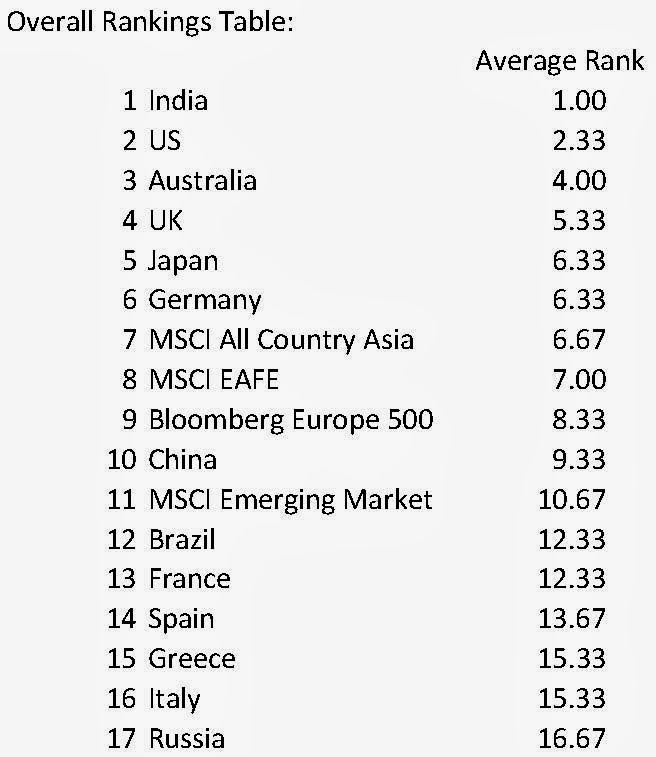
Once again, it’s been a few months since we updated our valuation tables.  As in the past, we’ve included stock market indices for 13 countries across the developed and emerging market spectrum.  We also throw in a few developed and emerging market indices to show how the broader international areas/regions stack up against one another.  We take three indicators broadly used by many value-oriented practitioners—10-Year CAPE P/E, Price to Book, and Enterprise Value to EBITDA—rank the countries in each category from highest valuation (relative overvaluation) to lowest valuation, then average across the categories to provide an overall score to determine position.  The lower the average score, the higher the relative overvaluation and vice-versa.  All ratios are based fundamental data provided by Bloomberg.

Here are updated results as of 10/4/13:


Valuation Conclusions:
  • While the overall MSCI Emerging Market index has taken a relative beating this year, reflected in the fact that the MSCI Emerging Market Index sits in the lower portion of the table, India remains the most overvalued across all three indicators on a relative basis.  Among the BRIC country indices, the India SENSEX Index has held up reasonably well over time.  Brazil, Russia, and China indices are all decently below 2008 highs, but the SENSEX has held its ground, even though overall economic and market prospects have become cloudier.  Perhaps the valuation tables above indicate that Indian markets will play catch up and pay a price over the next several years in terms of poor relative performance.
  • The US comes in at a close second to India in terms of relative overvaluation.  We’ve discussed in past valuation posts and in our chartbook that historical analysis shows that future 10-year total annualized returns for the US are predicted to fall three to four percentage points below the long-term historical average per annum.  Australia, UK, and Japan round out the top five portion of the table when it comes to individual countries.  Japan has witnessed a phenomenal run over the past year on the back of the Abenomics announcements.  Fundamentals are going to have to start catching up, though, for momentum to continue.  Japanese markets have basically moved sideways over the past five to six months and momentum is waning.  Australia benefitted mightily from China’s growth over the past decade.  There could be a moment of truth for Australian investors as markets adjust to new realities about China’s future economic path.  The UK has rallied in recent years, but equity market prices have remained ahead of broader economic realities.
  • Within the developed market category, France, Spain, Italy, and Greece continue to occupy the bottom spots, ex-Russia.  Valuations have recovered off the rock-bottom levels observed during the main portion of the European crisis.  Still, markets continue to price in significant pessimism.  These markets have a strong chance of providing outsized relative returns over the next decade, if history is any guide.  Economic momentum is beginning to turn in the periphery countries.  Like an individual value stock, all it takes is a few better than expected economic surprises to attract investor capital into the vacuum.  
  • Looking at the broader indices, the MSCI EAFE, representing developed markets ex-US, scores better than the United States, while the Emerging Markets Index remains the most attractively valued on a relative basis.  Breaking down regional international indices, Europe scores better than Asia. 
  • Russia continues to occupy the bottom of the table.  Like the broader Emerging Markets Index, Russia’s equity markets have basically treaded water since 2006/2007 performance wise.  Nonetheless, Russia has rarely been able to command robust valuation multiples over time.  Russia’s reputation among international equity investors remains very spotty due to numerous issues surrounding trust, corporate governance, misappropriation, corruption, and other issues.  
  • Based on valuation alone, we’d still argue that Emerging Market equities should provide better overall total returns over the next decade compared to their developed counterparts, though investors would probably be wise to also look beyond the BRIC countries for opportunities.  Within developed, we continue to believe that European equities will outperform their Asian or US counterparts over the next several years, most likely driven by rebounds in the periphery.  Again, as the southern European economies begin to show signs of stabilization, there could be significant room for multiple expansion.
  • Our standard “disclaimer” applies as usual.  Many fundamental indicators prove their efficacy over multi-year time frames and, thus, shouldn’t be considered great short-term timing indicators.  Don’t take this as indication that we expect Indian markets to collapse 50% over the next 12 months, or that we expect Italian markets to skyrocket.  From this point forward, over time, history shows the odds work against the countries/indices at the top of the table and for the ones at the bottom.

Friday, September 27, 2013

Fundamental Free Lunches


As we’re a little hurried today in preparation for travel to a 20th high school reunion, we thought we’d present a simple example to show how use of fundamental metrics, even using the simplest strategy possible, can provide outsized returns over time.  There are a few catches, however, as we’ll see.  
For this experiment, we used Bloomberg’s factor back-testing product to evaluate whether or not using a simple and widely used fundamental metric, Enterprise Value to Trailing 12-month EBITDA, provides excess return over time.  We used the S&P 500 as our universe and grouped the results into deciles based upon EV/EBITDA, with lower valuations being better.  Portfolios were rebalanced annually (year-end) in this exercise. Positions are equally allocated.  For individual stocks without valid data, we assigned the stock the universe median multiple.  Bloomberg in this instance will only allow us to go back to year-end 1993.  Thus we considered annual results between 12/31/1993 and 12/31/2012.  Ultimately, our interest lies in determining whether buying the 50 or so stocks in the first decile each year provides any benefit in terms of excess return.  To make sure performance calculations remained “apples to apples,” we used Bloomberg’s universe performance calculations instead of official S&P 500 performance to benchmark the model against; in some cases, especially the results from the 1990s, less than 500 stocks were included in the database.  In any case, the universe annualized returns are higher than the S&P 500 over that time.
Here are the results from the exercise.  Underperformance results are highlighted. 
IronHorse Capital
Overall, simply buying top decile EV/EBITDA stocks each year through an annual rebalance produced annualized returns of approximately 2.5% per annum higher than the universe return.  Behold the power of compounding as the annualized returns translate into a 927% total return for the model over those 19 years versus 576% for the total universe.  Seems easy right?  It’s always easy when looking a historical numbers on a page.
Here are the gotchas that trip up many attempts to implement and follow a disciplined fundamentals based strategy, whatever your favored metric.  
First, and most importantly, one must overcome the tugs and pulls of human psychology.  Note above that the model underperformed in 7 of 19 years and that there were a few years with dramatic underperformance.  In 1998, the model underperformed by approximately 16.5%.  In 1996, it was over 9 percent.  Furthermore, pretend that one had actually implemented this strategy starting 12/31/1993. It would have been incredibly hard to justify sticking with it at first.  The strategy underperformed the universe four out of the first six years in this example, with two of those outperformance years being among the worst.  Our irrational brains would have been telling many of us to throw this strategy in the trash at various points.   From another angle, many would have shied away from the strategy simply because the names picked weren’t the belles of the ball.  Looking back over time, many of the low valuation stocks chosen each year weren’t necessarily the most attractive names from a press and media standpoint.  Companies reach low valuations for a reason.  As we’ve discussed in the past, it’s very difficult to ignore the noise surrounding these names. 
Second, the strategy was more volatile than the total universe returns, not to mention there was no rhyme or reason in terms of downside protection.  Standard deviation for the strategy was 23.07% vs. 19.54%.  The strategy underperformed during the go-go growth-centric period from the mid to late 1990s, performed well during the dot-com crash years, hung in there pre-financial crisis, then provided little shelter during the 2008 crisis, underperforming by seven percentage points.  Of course, the model made up for it in a big way in 2009.  Still with a few large drawdowns and more volatile returns in general, it may have been difficult to some to stomach the ride.  Nonetheless, using a simple calculation of dividing returns by standard deviation, the return per unit of risk remained slightly higher than the universe, i.e. risk adjusted returns were still slightly better even with the higher volatility.  
In the end, practitioners are constantly asking why more don’t take advantage of these supposed fundamental free lunches the market provides?  Simply, it’s very difficult for individuals and professionals alike to execute a strategy consistently through thick and thin.  For many institutional investors, so-called career risk occupies an outsized portion of one’s thoughts.  At the first sign of trouble, many abandon the plan and chase the Johnny-come lately strategy.  We know from experience that there are periods where value dominates and periods where growth dominates.  Or large-cap trounced small-cap and vice versa.  Often, cycles go longer than even the most patient expect.  It’s hard to hold the line, but those that can exhibit discipline are often rewarded over time.

Friday, September 20, 2013

The Fed: Credibility is Overrated


As with many other overwrought business media storylines of late, the whining and moaning post-Fed decision has been amusing to follow.  Of course, the much anticipated Federal Reserve meeting concluded this week and the Bernanke-led Fed threw the markets and the media for a loop by announcing that pulling back on its long-standing bond buying program would have to wait for another day.  Almost immediately Fed watchers of all stripes, especially those convinced that the program is the root of all economic evil worldwide, condemned the decision.  Going into the meeting, consensus among market watchers and economists coalesced around the notion that the Fed would cut approximately $10 billion of purchases out of the $85 billion currently purchased monthly.  Now that the Fed had backtracked, Bernanke and the Fed all of a sudden faced a crisis of Fed “credibility.”  We’ve seen plenty of questions wondering whether the Fed can be trusted anymore or whether markets are due for disruption because the Fed had deviated from consensus.  While equity and bond markets rallied, let’s keep in mind that 10-year yields have moved approximately 15 basis points (i.e. not very far) since the announcement.  Similarly, US equity markets are actually up less than a percent since the decision.  The US dollar index moved down by approximately 1%.  Markets seem rather unmoved by the decision, perhaps reflecting the fact that any tapering at this stage, if implemented, was rather insignificant to begin with.  Surely, Treasuries have moved higher by approximately 100 bps in recent months, supposedly in anticipation of the Fed announcement.  We’d argue that the move was more technical in nature, the result of an absurdly overbought and oversubscribed market due for an outward stampede of some sort, but we’ll leave that for another day to debate.  
Forgetting the market moves for a second, let’s return to the notion of Fed “credibility” in broader terms.  The Bernanke Fed has certainly worked hard in recent years to increase transparency and communication with the broader public in terms of the future path of conventional and unconventional interest rate policy.  Goodness knows we get bombarded with speech after speech from the Fed governors, each of which is parsed and reparsed.  Now, we have the pleasure of watching the Fed chairman face the media directly for questioning after a Fed meeting conclusion instead of having to rely solely on a cryptic one page Federal Reserve statement.  In many respects, whiny market participants asked for this type of transparency over time.  Now that it’s been provided, market watchers are quick to bludgeon the Fed with its own instrument when things don’t go entirely to (their) plan.  Yes, “credibility” or keeping one’s word in an admirable quality when it comes to personal relationships and business-dealings.  But these are policy makers, and sometimes conditions on the ground change over the course of months, weeks, or even days and hours.  Their obligation presumably at any point is to adhere as close as possible to legal mandates and long-term economic goals, not to satisfy the market’s notion of credibility or consistency of message.  
What are their legal mandates, by the way?  This has been lost in a lot of the discussion over the decision and the debate over the merits of unconventional monetary policy.  By statute, the Federal Reserve is held to a dual mandate of working towards “full employment” and price stability.  As of this moment, it’s fair to say that neither obligation is close to being satisfied.  It’s obvious with an official unemployment rate at 7.3% percent and an employment to population ratio at or near the lowest levels in a generation that we are far from reaching any sort of economic notion of full employment.  Meanwhile, even with globs and globs of so-called monetary stimulus, year over year core inflation in this country is dangerously close to stall speed.  As of the last reading in July, year over year core inflation was a measly 1.2%, not far at all above lows reached during the height of the crisis.  This has actually fallen steadily over the past year and a half.  The Fed prefers to see a level closer to 2%.  Price stability goes both ways.  To any central banker, the prospect of entrenched deflation causes much more heartburn than price spikes.  As Volcker proved, inflation can be nipped in the bud reasonably quickly, though some short term to intermediate term pain is usually involved.  Deflation once it takes hold is a rot that is incredibly difficult to extract.  Just ask Japan after a 20 year spell of stagnation.  Or, go back much further and look at the situation faced by global leaders during the years of the Great Depression.  
Bernanke and his colleagues were obviously feeling sanguine about broader economic dynamics when they began floating tapering trial balloons a few months ago.  Something has now intervened, and it appears to be continued evidence that the US economy is having a hard time achieving escape velocity.  Economic growth is steady but unspectacular as we’ve pointed out of late.  It’s not enough, though, to enter the realm of “sustainable” as demonstrated by the sensitivity of metrics such as home mortgage applications to the back up in long-term rates in recent months.  Perhaps they opened themselves to slings and arrows by holding the line.  No matter.  It’s much better under the current economic (and political) circumstances to err on the side of caution.  
If there’s been any error in judgment by Bernanke over time, it may be the move towards copious communication with markets.  While it sounds great in theory, economic policy is a highly complex endeavor not necessarily compatible with sound bites and press conferences and 30 minute speeches.  The current economic environment is especially difficult to navigate.  It seems over the long-run this type of communication output might invite more trouble than it’s worth.  The entire credibility debate probably wouldn’t exist in any form if we were still guided solely by Delphic official Fed press statement releases.  Nonetheless, we can’t find any fault with Bernanke’s supposed change of course.  As economic time marches on, we’d much rather Ben Bernanke gravitate towards what’s best for the economy at large during a time of stubborn economic growth than worry about satisfying some notion of credibility with media and the markets.  If the global economy double-dips into an entrenched deflationary cycle, Bernanke will have much bigger problems to worry about.  We can’t help but think back to the wonderful quote often attributed to economist John Maynard Keynes: “When the facts change, I change my mind.  What do you do, sir?”

Friday, September 13, 2013

Let's Get Technical


So much emphasis is placed on fundamental analysis of individual stocks and broader market indices in the popular press and in general discussion about investment products that technical analysis can get lost in the wash.  What is technical analysis, for those not necessarily familiar with the concept?  Without getting too far off the reservation, technical analysts generally use indicators based on stock charts, stock price movements, or other details to make buy and sell decisions.  Generally, indicators fall into one of the following categories: trend-following, which includes indicators such as moving averages; overbought/oversold indicators; momentum indicators; or indicators providing information on market “internals” or market “breadth.” Practitioners can use indicators in isolation or in combination with other indicators.  Time frames for analysis range from yearly data down to the microsecond.  There’s an extensive body of literature out there dealing with the subject. 
Fundamental analysis is the “backbone” of the industry’s stock selection and allocation process, and rightfully in our opinion.  Many studies have shown that using fundamental indicators and ratios such as Price to Book over longer periods of time can provide a statistically significant advantage.  On the other hand, studies on many technical indicators, especially studies focusing on single indicators from a pure performance perspective, have shown inconsistent results at best, leading some to declare technical analysis a “voodoo” type approach to stock selection or market allocation.  We think this categorization is unfair and that many critics often miss the forest for the trees when it comes to incorporating technical techniques into a largely fundamental process.  Yes, there are plenty of individuals, funds, quant investors, and the like using technicals solely to drive decision making.  Many do quite well from a pure performance standpoint.  We tend to look at it, and appreciate it, from a slightly different perspective, namely a risk management and discipline perspective.  Instead of focusing on the performance attributes of indicators, we think it’s just as important if not more important to think about how incorporating this analysis into a fundamentally driven process can help one maintain objectivity, consistency, and discipline in process, and avoid the pitfalls often associated with our bad behavioral human traits.  
Again, in theory, fundamental analysis can generate excess return if approached properly and in a disciplined manner.  Unfortunately, humans have always been and continue to be susceptible to human psychological mess-ups that end up undermining good fundamental work.  Behavioral finance has become a hot topic in recent years as academics and professionals have come to appreciate the performance problems associated with our psychological shortcomings.  What are some of the behavioral short-comings, quickly?  We’ll quote directly from a CFA Institute paper on behavioral finance:
• Overconfidence and overoptimism—investors overestimate their ability and the accuracy of the information they have.
• Representativeness—investors assess situations based on superficial characteristics rather than underlying probabilities.
• Conservatism—forecasters cling to prior beliefs in the face of new information.
• Availability bias—investors overstate the probabilities of recently observed or experienced events because the memory is fresh.
• Frame dependence and anchoring—the form of presentation of information can affect the decision made.
• Mental accounting—individuals allocate wealth to separate mental compartments and ignore fungibility and correlation effects.
• Regret aversion—individuals make decisions in a way that allows them to avoid feeling emotional pain in the event of an adverse outcome.*

Bottom line: we’re oftentimes our own worst enemy.  We just can’t help ourselves.  We buy the hot stock because all the news stories are glowing.  We ignore an undervalued stock that has all the hallmarks of a good fundamental buy from a valuation and fundamental stance because the last several articles we’ve read are cruddy.  We add to positions at exactly the wrong moment after they’ve run significantly higher and sell positions after they’ve collapsed because we just can’t take the pain anymore.  We seek out information that confirms our current ideas and theories and ignore news and information that tells us we may be wrong, a problem that’s been enhanced in the information age.  
Incorporating simple technical techniques can help avoid these types of mistakes, both at position entry and position exit.  With practice in terms of figuring out what indicators may work best in the broader fundamental portfolio context, rules can be set and used that inject complete objectivity into a process, thus undermining the ill-effects of the psychological biases listed above.  Using longer-term moving average, for instance, or longer-term momentum indicators can provide confirmation and trigger points for stocks or indices that are attractively valued, giving us confidence that a stock is under “accumulation.”  On the flip side, simple technical techniques can provide early warnings or triggers that a portfolio position is “breaking down.”  Ultimately, the holy grail is to allow winners to run and to cut losing positions before they become albatrosses.  This sounds great in practice, but is ultimately difficult to implement when relying on human judgment alone.  Under some market circumstances, this type of approach to the problem can enhance returns.  More importantly, this type of approach can demonstrably reduce risk of massive drawdowns and thus improve the risk-adjusted return of a portfolio over the intermediate and long-term.
Let’s use a very simple example provided by the Big Picture blog earlier this year, which was originally calculated and demonstrated on Mebane Faber’s website.**  Faber analyzed Dow Jones Industrial Average returns from 1922 to 2012 using a simple timing model based upon the 10-month moving average.  Basically, if the index closes below the 10-month moving average at the end of a month, sell.  Buy if it closes above.  Meanwhile, during periods when out of the market, place the money in T-bills or the 10-year Treasury.  Here are the results:
While annualized returns were essentially the same in this case (very simple model, again), the risk metrics over time are demonstrably better.  This strategy produced lower overall standard deviation (over 30% lower), higher Sharpe ratios, higher Sortinos, and a maximum drawdown (during the Great Depression presumably) that was basically half of the buy and hold strategy.  In practice, returns for many investors would have probably been much worse over time because of the biases we listed.  As demonstrated over the past two decades, many individuals and professionals alike have tended to dump equities at or near long-term market bottoms, and buy wholesale at market peaks, irrespective of the fundamental metrics arrayed ahead of them.  How many “new paradigm” metrics were created, for instance in the late 90s to justify buying stocks at 40x earnings?
A final note: incorporating rules into a fundamentally-oriented portfolio can create “whipsaws” in terms of position entry and exit.  No system is perfect.  This key over time in our opinion, though, is to avoid putting oneself in positions where you face a really bad decisions and heartburn.  It’s precisely those moments where massively destructive portfolio decisions are made.  How many folks were fully invested in late ’08 and early ’09 who decided they “couldn’t take the pain anymore” and decided to completely liquidate at market lows?  Many of these same investors have missed a good portion of a rally over the past four and a half years.  Emotion and psychological biases played a huge part.  We’re only human and can’t turn our brains off.  Combining technical processes with fundamental metrics can help overcome the destructive fight or flight portions of the investing brain.
*Alistair Byrne and Mike Brooks.  “Behavioral Finance: Theories and Evidence.”  The Research Foundation of CFA Institute Literature Review.  Volume 3, No. 1.  2008.  
**Barry Ritholtz.  “200 Day versus 10 month Moving Averages.”  2/13/13.  http://www.ritholtz.com/blog/2013/02/200-day-versus-10-month-moving-averages/

Friday, September 6, 2013

Can the Fed Model Provide Any Help in the Equities vs. Debt Debate?


For years, practitioners have debated the efficacy of the so-called “Fed Model” in terms of its ability to forecast future equity market returns.  For the uninitiated, the Fed Model is simply the ratio between the so-called earnings yields for the S&P 500, basically the inverse of the P/E ratio, and the yield on the 10-year Treasury bond.  Theoretically, a high earnings yield vis-à-vis bond yields indicates an equity market that is undervalued, or at least poised to outperform bonds.  Numerous studies have been performed on the Fed Model; many of them have proved inconclusive at best when it comes to establishing a statistical link between the model and future returns.  Like other debates we’ve waded into in the past, we’re not going to attempt in any way to break any new ground on the core debate.  Instead, with the massive uptick in Treasury yields and the steady progressive move higher in the S&P 500, we thought it would be interesting to take a look at the dramatic gyrations in the Fed model in recent months and years and see if we could draw any conclusions.  Likewise, we thought it might be interesting to create a “Corporate Bond Model” that substitutes investment grade corporate yields for Treasury yields to see what, if any, type of insight that might provide.  
First, let’s dispense with a few housekeeping items. We calculate our Fed Model monthly going back to 1962.  For earnings yield, we take the inverse of the Shiller 10-year P/E at the end of each month; we feel this provides more stability and consistency than a simple trailing 12-month P/E.  At each month end, we divide the earnings yield by the 10-year US Treasury yield, thus providing the Fed Model ratio.  Higher values indicate equity undervalution.  Lower values indicate overvaluation.  For our “Corporate Model”, we use the same calculation for earnings yield, but use the “FINRA – BLP Active Investment Grade US Corporate Bond Average Yield” for the denominator.  Presumably, a higher ratio indicates equities are in a better position relative to their corporate bond cousins, while a lower ratio indicates the opposite.
Let’s begin with a chart of our Fed Model:

We’ll concur with those that have worked on this in the past that there is a general weak statistical significance when it comes to the Fed Model’s ability to consistently predict future returns.  A few things stand out though.  First, look at the dramatic gyrations since the financial crisis in ‘08/’09 and how unusual these gyrations are compared to past history, not to mention the Fed Model ventured into territory not seen at any point over the prior 50 or so years.  Obviously, this reflects the volatile downward march in 10-year yields from over 5% prior to the crisis to a low of near 1.5% last summer back to the current level near 3%.  Similarly, S&P 500 multiples moved dramatically, falling from the 20s prior to the crisis, to the very low teens, back into the 20s as the recent cyclical bull market has progressed.  There’s been dramatic movement in the numerator and the denominator of the ratio during the past five years.  On balance, the moves have kept equities in the extreme undervalued camp.  Even with earnings yields declining with valuations creeping higher, compared to historically low Treasury yields, they look fantastic (again theoretically).  Second, it appears to the naked eye that the model does a decent job of foretelling the future path of equity returns when the model reaches extremes (the dark band represents the area between +1 and -1 standard deviation from the mean).  The extreme undervaluation indicated in the mid 1962 time frame proved a solid point to buy equities for what turned out to be six year run to secular bull market highs.  Similarly, the undervaluation extreme represented in 1974 proved to be a solid spot to buy equities long-term, though it did take several years through the late ‘70s and early ‘80s to shake off the overall malaise of the secular bear market.  Conversely, we see the extreme overvaluation of the markets in 1999 captured as well.  We all know the story from 2000 to 2008 in terms of frustratingly negative market performance.  Then, as pointed out, the model entered extreme equity undervaluation territory with the crisis.  As discussed, there have been wild gyrations and distortions over the past few years, but the model remained in the extreme undervaluation zone.  Lo and behold, the S&P 500 has rallied nearly 150% (including dividends) since March 2009.  
The recent downtick in the model is mostly a reflection of the fact that 10-year Treasury yields have spiked dramatically off last year’s lows.  We have to keep this in perspective though.  Going back to 1962, the average 10-year Treasury yield is approximately 6.5%.  We’re a long way from normalcy.  As such, the model remains in extreme undervaluation territory.  Does this mean equity markets are poised to take off like a rocket ship from these levels.  Not necessarily.  Of course, as we’ve seen in recent months, the denominator can continue to move dramatically affecting the ratio.  It’s probably better to frame the extreme condition of the ratio in terms of future performance relative to the Treasury market.  We think it’s reasonable to believe that equity returns, whatever the tenor, have a decent shot of outpacing total Treasury returns over the next several years.  
Turning now to the aforementioned “Corporate Model”, we see a similar situation.  Here is the chart:

Our data on corporate yields only goes back to 2002.  This chart shows less volatility than the Treasury-based Fed Model owing to the fact that this corporate index hasn’t varied as wildly.  Like the traditional Fed Model above, this corporate yield-based model was showing a problematic situation for equities relative to corporate bonds in late-2007.  As the crisis progressed, this reversed towards the extreme equity preference situation of late also observed in the Fed Model.  Perhaps this model provides a purer look at the situation between bonds and equities since focusing on corporates dampens the accusation that the bond/equity relationship as captured in the Fed Model is meaningless because of the massive Fed intervention.  Granted, Fed action has affected bonds/yields across the spectrum, but corporate bonds are more insulated from this affect in a way since the Fed isn’t directly intervening here as they are in Treasuries.  Nonetheless, the picture follows the same script as written for the Fed Model.
Closing out, what’s the quick bottom line here?  The Fed Model and equivalent models aren’t great for making investment decisions in many cases, but seem to provide meaningful color when they’ve reached historical extremes.  Whether looking at Treasuries or corporate yields, we still see ratios that are at/near historical extremes, with models expressing a preference for equities over bonds.  Going forward, we continue to believe equities, both global and domestic, will provide better returns over coming years than bonds (viewed in terms of total returns), though this does not necessarily mean that absolute total returns for equities will be stellar.